

ASPARAGUS
A woman’s place


Spoilers for Asparagus (1979). Trigger warnings for discussions of misogyny
In just under 16 minutes, Suzan Pitt’s short Asparagus bombards the viewer with imagery. Deeply tied not just to a woman’s sexuality, but her presumed role within society based on whether she expresses that sexuality or hides it away.
It also has one of the most audacious stop-motion sequences I have ever seen, with a huge number of moving parts combined with hand-drawn animations that continue throughout.
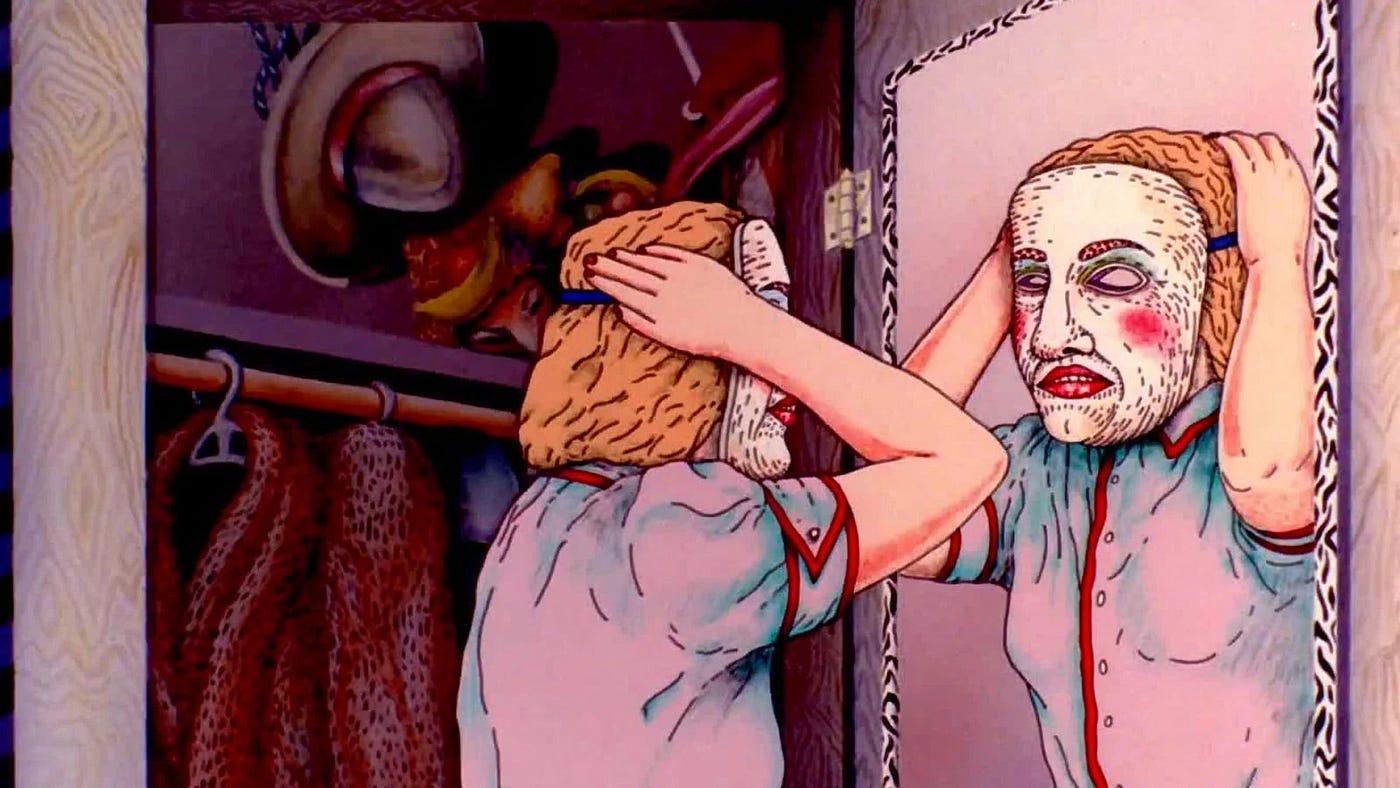
But that’s getting ahead of ourselves. The film follows a woman without a face – literally without a face. Already steeped in the idea that women are not desired for their faces, which has a mouth that can express thoughts and desires of their own, but for their bodies. Pitt hammers this idea home by having the character put on a grotesque, made-up mask before she leaves the house. Her natural features, or lack thereof.
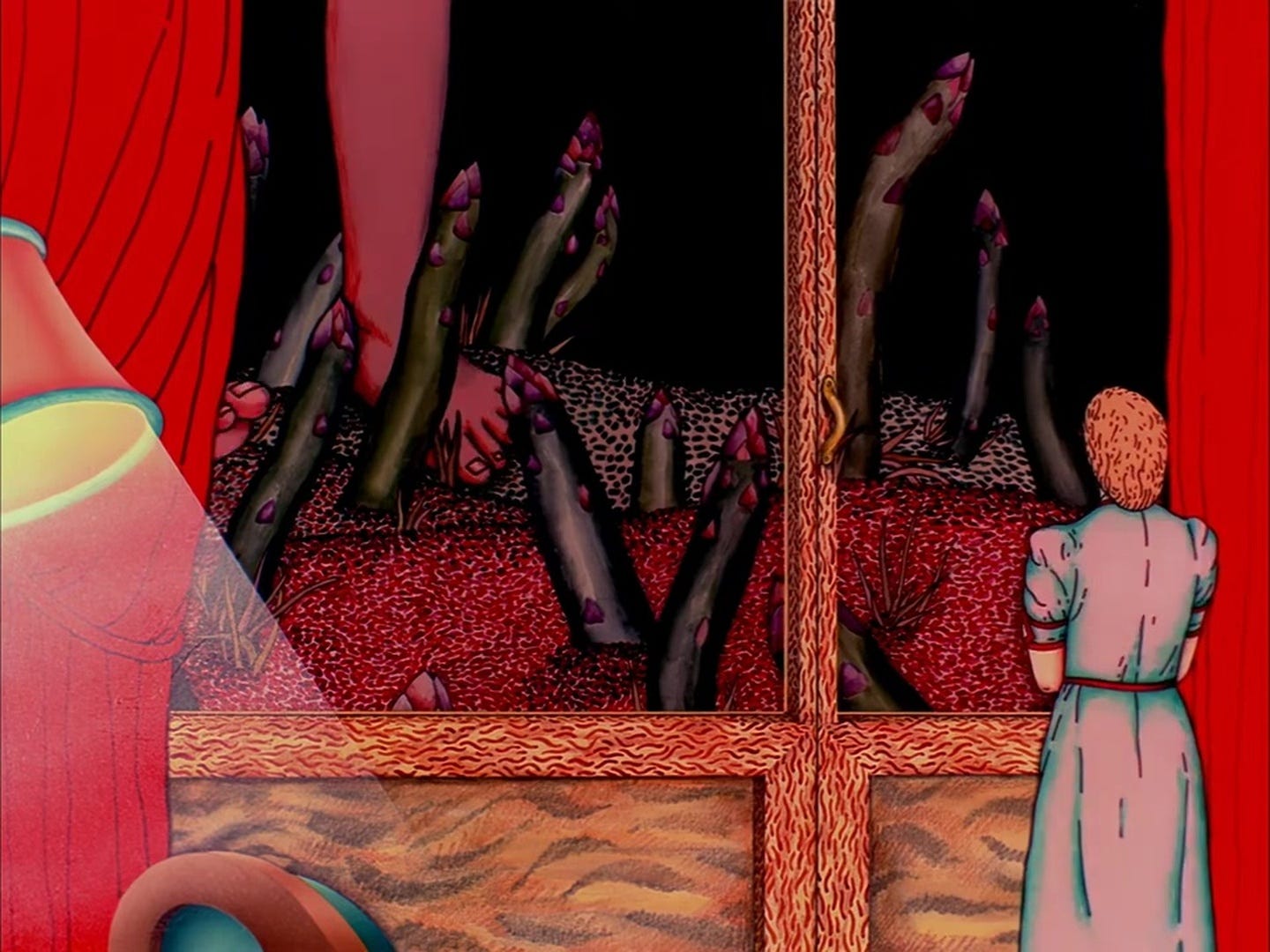
She broadens this departure from the natural order when the woman opens the curtains. Initially revealing a vast and varied array of flora and fauna, though still not without its own sexual imagery, which shifts out of frame to show a landscape of asparagus sticking out of the ground.
The phallic nature of the plant is no accident. As Pitt suggests, when women view the world, they see it as one dominated by men. A world ruled by those who see women as little more than vessels. When she sees someone walk across the landscape, gently stroking an asparagus plant, we see that direct connection from the penis to the ego. The constant need for validation both from society and sexually when at home.
And yet the film continues to be relevant today. Aggression towards women continues to be frighteningly high, with the impersonal nature of online communication making it easier than ever to degrade women, to minimise their roles as anything else but a sexual object.
Pitt is particularly fierce when we see the character – hidden behind the make-up mask – walk to the theatre. Behind her, we see advertisements for sex shows, followed swiftly by a gun store. A visual connection is made between sex and violence, even as we quickly pan to the next image.
In the next window are two naked, childlike dolls, disturbingly made-up in the same way as the woman’s mask. A clear comment on men desiring younger women. This is clear not just in the real-world relationships we often see, where men will pursue women that are half their age, but also in the way that some singers are presented – dressed like a young teenager, hiding innuendo behind a veil of innocence.
As I write that, I’m reminded of Jade Hurley’s excellent article on the topic ‘your face is selling a pedophilic fantasy’.
Asparagus was shown in a double bill with David Lynch’s Eraserhead on release. On the surface, the surreal, sometimes grotesque nature of the two films makes them a perfect match, but the connection goes even further. If Lynch’s masterpiece was about the fear of fatherhood, then Asparagus examines the before and after.
What happens when women live in a world dominated by dick-swinging misogynists, and what happens when the child you are terrified of bringing into existence must deal with the same subjugation generations later?
Director: Suzan Pitt
 | A guest post by
|
I was particularly thrilled to see this post arrive in my inbox, as I just recently watched this short myself. This was such a pleasure to read!
One of my favorite animations! Thank you for writing about it, I have already an ideal about a restack-post. Thank you for an inspiration in the morning. 🤍